

Q&A with Professor Fernanda Arreola: On What Makes the Modern MBA Meaningful
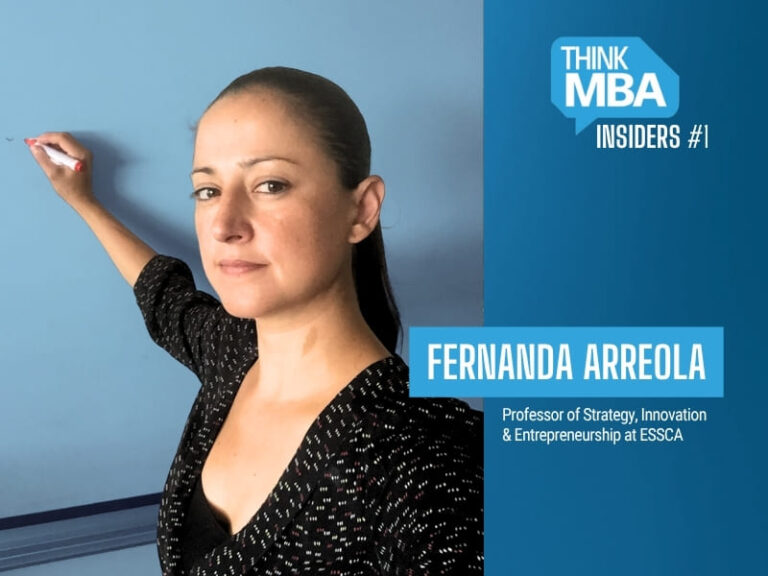
Editor’s Note: Welcome to The MBA Insider Series, a new ThinkMBA series spotlighting the individuals shaping business education today. In each edition, we speak with professors, program directors, and admissions leaders whose perspectives illuminate how MBA programs are evolving and what applicants should know before stepping into the classroom.
For this feature, we sat down with Professor Fernanda Arreola, researcher, entrepreneur, and long-time faculty member at ESSCA. With experience teaching across Europe and the Americas, and a background that spans innovation, leadership, and the future of learning, Fernanda brings an unusually global and candid take on what still makes the MBA powerful, how applicants can better prepare, and why authenticity matters more than ever.
“The best MBA programs don’t just teach business, they transform how you see the world and who you become.”
ThinkMBA: Is an MBA still worth it?
Fernanda Arreola (FA): Absolutely, but it depends on your goals. For me, it was transformative in three ways: First, it enables a complete career pivot, which I believe is nearly impossible without the MBA knowledge base. Second, you gain exposure to cutting-edge business frameworks and case studies that you can apply immediately. Third, the global network is invaluable. I still collaborate with classmates from different continents on projects today, and I made some profound friendships too.
TA: How long does it really take to see ROI?
FA: The financial ROI became clear around year 5 when my increased earning potential and my personal ability to deploy fully the knowledge that I acquired allowed me to offset the program costs and opportunity costs. But the broader ROI started immediately—within months—as I was using strategic frameworks from class in my work, and my network helped me land my first post-MBA role. The returns keep compounding; just this year I am working with one of my MBA professors on several academic articles.
TA: What was the most valuable outcome of your MBA?
FA: The relationships, hands down. But it’s not just the quantity, it’s the quality and diversity. These aren’t just professional contacts; they’re people who challenged my thinking, became business partners, and remain close friends. The alumni network spans industries and continents, so there’s always someone to call for advice, collaboration, or opportunities.
TA: What three pieces of advice would you give to current or future MBA students?
FA: Three key points: First, treat it as a full-time commitment; if you’re pursuing it part-time in an Executive Education program while working, consider negotiating reduced hours or responsibilities. Second, participate in as many events as possible at the beginning, then focus on the industries and areas that interest you the most for your future career. Third, invest in relationships beyond your immediate classmates. Do not hesitate to engage with faculty, staff, alumni, and visiting speakers. You get out what you put in!
Evaluating and Navigating MBA Programs
TA: How should prospective students evaluate MBA programs beyond marketing claims?
FA: When I chose Thunderbird in 2007, it was ranked #1 by the Financial Times for international management. But to ensure the experience matched the rankings and accreditations, I spoke with alumni, visited the campus, and asked hard questions about career outcomes and pedagogy.
“Participate in as many events as possible at the beginning, then focus on the industries and areas that interest you the most for your future career.”
My advice is to reach out to current students and recent graduates. Feel free to ask uncomfortable questions positively, like, “What would you improve?” Second, examine the network’s depth, not just breadth. At Thunderbird, I built relationships with professors, visiting experts, and classmates that have lasted 15+ years and opened doors I never imagined. Third, look at whether the program’s values match yours. I did a sustainability certificate at INCAE in Costa Rica during my MBA, and I know that this marked me forever and shaped my later work, founding an edtech startup for retiring athletes.
The best MBA programs don’t just teach business, they transform how you see the world and who you become. That’s hard to capture in a brochure, but you’ll sense it when you engage deeply with the community.
TA: What early signs show whether an MBA program is well run?
FA: The first few weeks reveal everything. At Thunderbird, I immediately noticed three green flags that predicted a strong experience. Some red flags? Disorganized communication, inaccessible career services, or a culture of grade obsession over learning. If students seem stressed and isolated rather than energized and collaborative in week two, pay attention.
TA: How can students make the most of their MBA network?
FA: Your MBA network is your most valuable asset, but only if you approach it with generosity, not transactionalism. At Thunderbird, the relationships I built with professors, visiting experts, and classmates from 40+ countries have been invaluable, not because I “networked strategically,” but because I was genuinely curious about their perspectives and offered help when I could.
Applications: Essays, Interviews, and Preparation
TA: Many applicants find MBA essay prompts vague. What’s their real purpose?
FA: MBA essays frustrate applicants because they often ask things like “describe your leadership journey” or “how will you change the world?” These feel impossibly broad. But here’s what schools are really assessing: Can you tell a coherent story? Do you have self-awareness? Can you connect your past to a plausible future? Authenticity matters, in my opinion, more than anything!
TA: What are the most common interview mistakes, and how can applicants do better?
FA: The biggest mistake? Rehearsing generic answers rather than preparing authentic stories. I’ve interviewed Graduate candidates at ESSCA, and I can immediately tell when someone is reciting a script about “synergizing cross-functional teams” versus genuinely reflecting on a difficult experience.
Here’s what works: Prepare 5–6 concrete stories from your career that show different competencies such as leading through ambiguity, recovering from failure, collaborating across cultures, and making ethical trade-offs. Then practice telling them conversationally, not robotically.
When I founded My Dual Project, an edtech startup for retiring athletes, we had to pivot our entire business model when COVID decimated sports budgets. That failure taught me more about resilience and adaptability than any success story, and that’s the kind of honesty interviewers respect.
The Future of the MBA
TA: How has the MBA evolved to stay relevant?
FA: The MBA has evolved from a “general management” credential to a platform for transformation, specialization, and learning about the impact of new tech in a fast-evolving world.
TA: How will AI and technology reshape business education?
FA: First, AI is personalizing learning at scale. When I founded My Dual Project in 2019, we created an online undergraduate program adapted to retiring athletes’ chaotic schedules. We used adaptive learning technology to personalize content delivery, something that seemed cutting-edge then but is now standard.
Today, I use AI tools to analyze student performance patterns, generate case study variations, and provide instant feedback on strategic frameworks. This frees me to focus on what humans do best: facilitating debates, coaching through ambiguity, and building relationships.
“MBA programs must focus on judgment, creativity, ethical reasoning, and cross-cultural intelligence, skills AI can’t replicate.”
Second, AI is shifting what we teach. MBA programs must focus on judgment, creativity, ethical reasoning, and cross-cultural intelligence, skills AI can’t replicate.