Contact Us
[email protected]

Executive Edge: Heart-Based Leadership
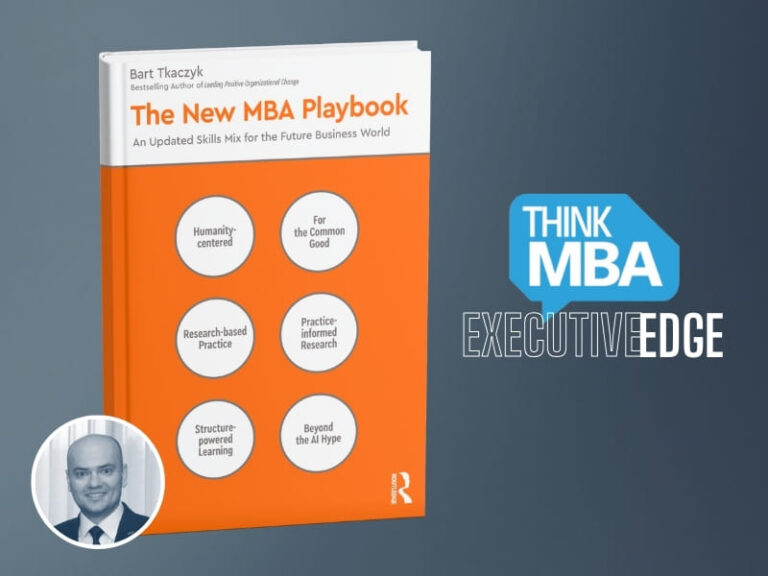
| Executive Edge: The New MBA Playbook in Practice Translating strategy into real-world results |
| Executive Edge is a new column authored by Bart Tkaczyk. Inspired by his latest book The New MBA Playbook: An Updated Skills Mix for the Future Business World (London & New York: Routledge), Executive Edge reveals the human and organizational dynamics that make or break strategy. Each column distills the latest management research into practical, next-day leadership moves. |
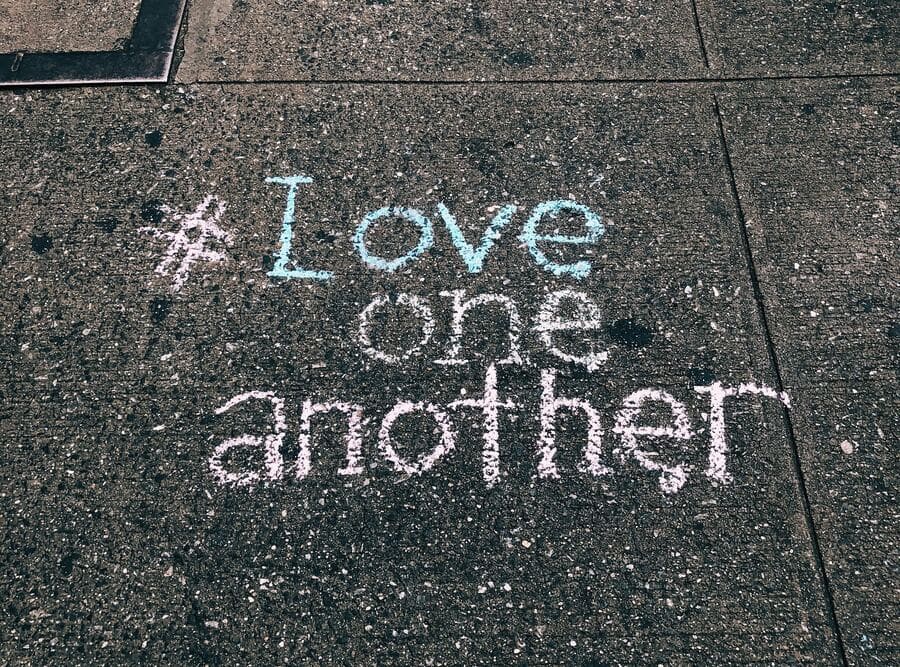
https://unsplash.com/photos/love-one-another-chalk-written-on-concrete-floor-UK61KZPnpyY
“Leadership is love.” — Mark Rittenberg
- A technically brilliant, hard-driving executive delivers targets through pressure and ego. People comply. Results follow—briefly. But soon, energy drains from the system. Creativity fades, discretionary effort disappears, and burnout rises.
- A newly appointed leader optimizes everything through dashboards and KPIs. Decisions are fast. Processes tighten. Costs fall. But people feel invisible. Conversations shrink to metrics. Initiative stalls. Within months, engagement drops and quiet quitting spreads.
- A control-driven manager centralizes every decision, reviews every slide, and second-guesses every move. Progress slows. Accountability blurs. Top talent stops taking risks—and eventually starts looking elsewhere.
Recognize the pattern?
It’s a recurring executive blind spot: we over-index on technical rationality, command, and control—and underinvest in leadership character and the human and organizational energy that sustains performance and the heart that powers it.
What’s missing is a more complete leadership equation.
The Real Leadership Equation: Leadership Is Shared
For decades, organizational scholars and management thinkers have focused almost exclusively on leaders. At its core, leadership is the process of energizing others to contribute their best efforts toward the creation of value and shared success. Yet leadership is only half the story. The other half—often ignored—is followership.
Effective leadership cannot exist without engaged, co-active followers. Leadership is not a solo act; it is a relational process, fueled by trust, respect, and high-quality human connection.
Several years ago, management scholars asked faculty at West Point how they develop leaders. Their answer was simple: we begin by teaching them to be followers.
Leadership and followership are not fixed roles but dynamic functions. In high-performing systems, individuals move fluidly between leading and following depending on context and expertise. Leadership becomes shared, developmental, and situational—rather than positional.
Importantly, this reframes power. It dismantles models built on entitlement and fear. There is no place in modern organizations for tyrants who confuse dominance with effectiveness. Real leadership creates space for others to lead—and knows when to step back, strategically.
Leadership is the process of energizing others to contribute their best efforts toward the creation of value and shared success.
This isn’t just organizational theory—surprisingly, even children grasp this instinctively. Before they can speak in full sentences, humans already distinguish leaders who earn respect from bullies who rely on fear. Toddlers expect leaders to step in when rules are broken. By early childhood, people view leaders as responsible stewards of the group—not as entitled figures. They recognize that real leaders give more than they take. And from infancy onward, humans consistently prefer helpers over hinderers.
In other words—and at a deeper human level—long before we learn organizational charts, we already know what positive leadership should look like. Children intuitively understand that real leaders are good people first—full stop. The real question is: do we still remember that once we become adults and titles, incentives, and power enter the room?
That insight points directly to kindness.
Kindness and Positive Energy Aren’t Soft. They’re Strategic.
In organizations, kindness—long dismissed in executive circles as “soft”—turns out to be a hard advantage. Positivity is not about surface-level niceness or being agreeable—it’s about how energy moves through an organization. That energy is contagious.
Kindness and positivity show up as:
- A small act (everyday moments that energize)—for example, a leader publicly recognizing effort or checking in with someone who looks overwhelmed.
- An event (deliberate, highly visible moments of care that signal values, realign culture, and reset expectations)—such as standing with employees during a difficult restructuring or personally welcoming new hires.
- An intervention (decisive leadership action that protects people, restores dignity, and rebuilds trust when it matters most)—for example, mobilizing immediate support after a community crisis or rapidly redesigning work to protect employees and their families.
These positive leadership behaviors generate positive organizational energy—the strategic fuel that drives engagement, innovation, learning, and execution.
Empirically, organizations powered by high positive energy—what I call Thrive Orbit—consistently outperform those stuck in the following patterns (a theme I expand in my next book on Human Resource Development):
- Oasis Valley (low positive energy): Stability and comfort dominate, but ambition fades, innovation slows, and growth stalls.
- Lethargy Lair (low-level negative energy): Teams are disengaged. Motivation is low. Some work gets done, but progress is minimal.
- Turbulence Territory (high negative energy): Activity is intense but chaotic. Energy turns destructive, driven by pressure and conflict.
The goal is clear: operate in the positive productive energy zone, where people flourish and results compound. And here’s why: organizational energy doesn’t appear by accident—it is built or depleted by the invisible assets leaders choose to invest in every day.
The Hidden Assets: Beyond Financial Capital
Most executives are fluent in financial capital (resources and assets), human capital (skills and capabilities), and social capital (networks and relationships). Beneath these lie two often-overlooked multipliers: psychological capital (PsyCap)—hope, optimism, confidence, and resiliency—and spiritual capital, the motivation, energy, and strong work ethic one draws from a relationship with God.
In leadership practice, these inner resources show up as resilient thinking, grounded decision-making, and the ability to bounce back from failure while lifting others. They shape how leaders respond, recover, decide, and care—especially when the pressure is on.
Unlike relatively fixed personality traits, PsyCap is measurable, developable, and performance-linked—making it open to targeted learning and development. Even brief, evidence-based interventions—such as neurofeedback paired with executive coaching—can materially raise PsyCap levels and deliver meaningful ROI. Leaders who invest here are not indulging sentiment; they are strengthening a strategic asset.
Spiritual capital deepens this effect. When people connect their work to purpose, meaning, and core values—and cultivate that connection through imaginative contemplation practices such as meditation or by routinely capturing three to five moments of appreciation in a simple gratitude log (daily or weekly)—they don’t just work harder; they work with direction, clarity, and sustained commitment.
Taken together, psychological and spiritual capital shape how generously people show up for one another. And that introduces a critical leadership tension.
The Generosity Paradox
Predictably, generosity drives cooperation—but unmanaged generosity burns people out.
Three patterns typically emerge:
- Self-protective givers (generous with boundaries),
- Matchers (transactional reciprocators),
- Takers (extractive and entitled).
The executive challenge is not to “be nice to everyone,” but to design norms that reward contribution, protect energy, and prevent exploitation.
Left unmanaged, takers drain systems. Healthy generosity—rooted in care and boundaries—lifts people and results alike.
Executive Applications: Turning Positivity into Performance
So how do leaders activate all of this in daily practice?
These insights translate directly into concrete leadership action:
- Energy management: Lead energy, not just time. Monitor physical, emotional, mental, and spiritual (purpose-driven) energy across teams.
- Building and sustaining high-quality connections at work: Identify and amplify positive energizers who lift others’ performance.
- Daily leadership habits: Use brief check-ins to reinforce presence, learning, and relational strength.
- Culture design: Make kindness visible, practiced daily, and built into expectations—not left to chance.
- Gratitude practices: Simple rituals—such as short gratitude reflections or journaling—can measurably strengthen resilience and engagement.
Each of these actions is a practical way to energize the workplace. These are not cultural niceties. They are execution levers. And in today’s business reality, execution is everything.
Why This Matters Now
In turbulent environments, organizations don’t fail because strategy is unclear. They fail because personal, relational, and organizational energy collapses.
When executives practice non-naïve organizational positivity with intention, it creates upward spirals of trust, engagement, and performance—strengthening followership, multiplying leadership impact, and sustaining results over time.
Which means this isn’t a side program—it’s a strategic leadership imperative for today’s leaders.
A Call to Action
Positive energy is the fuel that keeps enterprises fired up. Critically, relational energy compounds through use.
Audit your organization’s energy.
Where is it building—and where is it leaking? Who energizes others—and who drains the system?
Design for generosity—with boundaries.
Reward contribution. Protect energy. Prevent exploitation.
Crucially—and this bears repeating—the kindness advantage is not sentimental.
It is strategic, behavioral, and measurable—showing up in engagement, talent retention, discretionary effort, customer satisfaction, trust levels, and how quickly teams turn ideas into action.
Where in your organization would a small act of kindness—offered intentionally—create the greatest leadership and performance return?
Small acts matter because they shift energy—and energy drives execution.
Leaders who understand this don’t just lead better.
They build organizations that last.
Journal Entry for Executives
Pause. Reflect. Ask yourself:
Why would anyone choose to follow you?
Support Material
To go deeper and accelerate impact for you and your team, access these executive resources:
- The Full Playbook – Explore all 14 units of The New MBA Playbook: An Updated Skills Mix for the Future Business World. Access the book: www.routledge.com/The-New-MBA-Playbook-An-Updated-Skills-Mix-for-the-Future-Business-World/Tkaczyk/p/book/9781032805559
- Strategic Briefing Video – A concise, executive-friendly micro-learning video outlining why today’s leaders need an updated skillset—and how to apply it immediately. Watch the video: https://youtu.be/Xrq34Jj2NMQ?si=5h2ePCoy465uCcSl
- The Visual Toolkit (Sized for A1 printing) – A poster-sized framework for workplaces and team spaces to spark dialogue around future-ready leadership. Download the poster: https://s3-eu-west-1.amazonaws.com/s3-euw1-ap-pe-ws4-cws-documents.ri-prod/9781003508274/The%20New%20MBA%20Playbook_Poster_Sized%20for%20A1%20Printing.pdf
Executive Edge equips you with practical tools to lead smarter—not harder. In the next column, I’ll explore Strategy, continuing to build on The New MBA Playbook (Routledge) to help you stay ahead in the future of business.
This is the second installment in the Executive Edge series. (Read installment 1.)
About the Author
Bart Tkaczyk, Fulbright Scholar (University of California, Berkeley—the #1 public university in the U.S.), Course Leader (mbasprint.com), and Executive Member of the Academy of Management (AOM), is Managing Member of ENERGIZERS, LLC, a U.S. strategic transformation consulting firm, and currently serves on the Advisory Board of GENEXRA LLC, a U.S. future-systems venture spanning space governance, policy, diplomacy, AI, cybersecurity, quantum technologies, strategic foresight, enterprise renewal, executive crisis communication, design innovation, advanced service design, and human advancement. He advises bold global leaders on strategy, executive leadership development, and large-scale change across sectors, blending academic rigor with practical insight. An award-winning consultant, behavioral economist and strategist, executive coach, case method instructor, and keynote speaker, he delivers impact where it matters most—boardrooms, executive classrooms, and transformation zones. His acclaimed Routledge books include Leading Positive Organizational Change: Energize – Redesign – Gel and The New MBA Playbook: An Updated Skills Mix for the Future Business World. He is now working on his third book, on Human Resource Development. On X: @DrBTkaczykMBA