Contact Us
[email protected]

How Emotional Intelligence Shapes Modern MBA Success in a Changing World
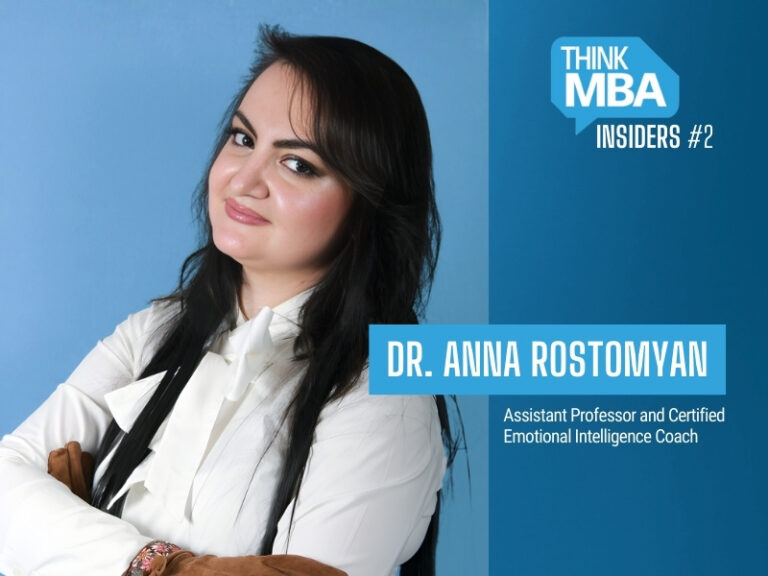
Editor’s Note: In this MBA Insider series, we sat down with Dr. Anna Rostomyan, assistant professor, certified emotional intelligence coach, and researcher active across European institutions. We explored her insights on leadership, emotional intelligence, and career growth. Anna provides a global and candid view on the enduring value of the MBA, practical ways for students to thrive, and why staying true to oneself is more crucial than ever.
ThinkMBA (TA): You have worked with MBA students across various European business schools for many years. From your perspective, what makes the MBA experience remain valuable in a world that is changing so quickly?
Anna Rostomyan (AR): First and foremost, thank you very much for inviting me to this interview on a very important topic, for your insightful question and for highly evaluating my expertise so far in teaching MA and MBA students across various European University including Berlin School of Business and Innovation (BSBI), Media University of Applied Sciences (MU) and currently Fachhochschule des Mittelstandes (FHM) (Germany).
In all those aforementioned business schools and universities of applied sciences I have witnessed an urge in my students to gain broader perspectives on the labour market and to experience the intersections of science and business first hand, as well as to gain invaluable insights on various business-related topics that are of high relevance to have in advance before stepping into the business world. I also acted as a PhD Mentor (both traditional and by Portfolio route) at Swiss School of Business Research (SSBR) and if I see the potential in my MA or MBA students that they can bring something of relevance to this world in terms of the academia and/or business, I provide guidance to them on how to continue their academic journey in the way of pursuing a PhD, PhD by Portfolio or DBA journeys.
“I also highly advise them to seek for part-time jobs to apply their acquired knowledge in the classroom in real world business-world scenarios.”
TA: Based on the patterns you’ve observed among your students, how long does it typically take before they start seeing real personal or professional returns from the program?
AR: Frankly speaking, most of them were and are willing to gain personal insights from the educator from his/her personal journey just from the very beginning. As we know, in the educational sector focused on the practical business field, namely universities of applied sciences, it is a pre-requirement to also have experience in the business sector (at least 3 years in Germany) and that is what I bring to the table. I have formerly worked as an HR Manager at Porsche Center Yerevan, have worked at various local banks, as well as act as an Angel Investor and Communications and Marketing Manager at our family owned business. Thus, I always strive towards delivering to the students not only pure academic knowledge, but also business-relevant experiences of mine, which they absolutely love. I also highly advise them to seek for part-time jobs to apply their acquired knowledge in the classroom in real world business-world scenarios and always assist them in providing them with recommendation letters. As for the results, they are becoming visible during the program, but very vivid especially after the course. Yet, the connection with the educator, in this case me, I believe should stay for lifelong and in case they require guidance or assistance from my side in the future as well, I am always open in supporting them in their activities which can bring both personal and professional returns.
TA: You’ve witnessed many MBA students navigate transformative growth. Which outcomes or shifts tend to create the strongest and most lasting impact on their careers or sense of self?
AR: Very interesting question, thanks a lot for that. So far, most of them have reported that they absolutely love those classes of mine where we dive deeper into the benefits of emotional intelligence and its significance both in our everyday lives and in the business sector. Many of them provided me with very positive feedback and showed positive reinforcement in learning more on communication and emotion management tips and techniques that can be applied both in our everyday and professional lives. They also told me that I create a positive working atmosphere, where my positive mood and positive attitude work as a ripple effect and stimulate them towards eventual personal, educational and professional success.
As for their transformative progress, apart from the strictly scientific curriculum, we also do creative exercises and research projects, which have a positive influence on their personal and professional growth, for example start of this year at Media University of Applied Sciences together with a group of my students we ran a scientific-business-oriented project on the “Relevance of Emotions in Human Resources Management”, which were published as blog articles by “The European Business Review” under the column titled “Exploring Organizational Psychology Trends in Human and Organizational Resources Management”, which greatly promoted the understanding of the students of the huge role and immense impact of emotions in the business sector, which in many ways positively influenced their sense of self and their future business-related activities making them responsible and emotionally-savvy citizens.
TA: Drawing from your work in emotional intelligence and leadership development, what three pieces of advice would you offer students who want to make the most out of their MBA journey?
AR: 1) Sleep well to regain and re-boost energy, 2) eat well to keep a healthy lifestyle, 3) dress well to maintain confidence and stand for prosperity leaving a room for the others in your surroundings to look up to you.
TA: With so many schools trying to stand out, how do you recommend prospective students evaluate an MBA program beyond marketing language and rankings?
AR: You are quite right, dear colleague, there are currently very many vast possibilities in choosing your MBA institution. I myself would recommend to look at the different cooperations of this or that institution with other institutions which truly shows the breadth therein. As well as, it is a good idea to look at the reviews of the previous students. Last but not least, they should look for the option that corresponds best to their pocket and their desire in which country to conduct their studies since cultural shock can also be involved if they change their native land; therefore, if the new country of their MBA institution matches their values and desires, they will be more apt in enjoying those MBA years of theirs with true passion and greatest pleasure, thus getting better results and gaining better outcomes.
TA: Early in the academic year, what signs help you determine whether an MBA program is truly well designed and effectively run?
AR: Usually as professors/lecturers/educators/teachers, we have the utmost chance to support our home institution(s) in helping design or re-design the educational content. So, apart from my teaching responsibilities and duties, I am also actively engaged in research. Thus, so far, I have always integrated my very own research and findings into my teaching curricula for I have always witnessed that the students are more motivated in case they receive up-to-date resources including my articles constantly published at The European Business Review, my Newsletter run on LinkedIn, my blog posts at Psychology Today, my research published at such renowned various publishing houses as Emerald, Springer, DeGruyter, MDPI, etc. Besides, at the very beginning of the programme, I seek for distinct feedback from my students on their likes and dislikes, their preferences, their motivations and intentions, their expectations and awaitings so that to match the delivered content accordingly which eventually brings very positive resonance amongst the students.
“Look for the option that corresponds best to their pocket and their desire in which country to conduct their studies since cultural shock can also be involved if they change their native land”
TA: Networking is often described as a key advantage of business school. How do you guide students to build networks that feel purposeful, supportive, and long term?
AR: Networking is truly very important in today’s business schools and universities of applied sciences across the world nowadays (for instance in Germany, France, Switzerland, Austria, etc.) put a great focus on networking events to be able to support their students in finding their future recruiters. So, it is highly advisable for those companies who look for young talent to participate in such networking events and find their prospective bright employees who will bring with them drive and passion, as well as novel insights, which will be greatly beneficial for this or that company at hand. I myself strongly believe that networking not only is very essential in the business world, but also in our personal lives since we truly thrive when surrounded with successful and supportive people driven by wisdom and passion. As they truly say, we are the average of the 5 people that we mostly interact with, so we should choose our circle wisely (smiles).
TA: Many applicants feel unsure about how to approach MBA essay prompts because they can seem vague. From your perspective, what are these essays really meant to reveal about a candidate?
AR: Writing an essay can truly be really challenging for those who do not have inborn qualities to put their thoughts in a structured manner onto paper as it is required in essays, especially university entrance essays. I usually advise my students to see essays as a structured means of affirming their standpoint on this or that topic and to be attentive to the essay prompt(s). I usually advise them before starting their essay to draft their key thoughts on a piece of paper, write several affirming examples, write the introduction and conclusion and the rest will flow naturally. It is here also highly advisable for the students to re-read their essay before submitting, as I say “with the eyes of another person” so that to see how well it will be perceived by the selection committee. Besides, it can also be a really good idea to ask someone from your circle to read your essay and provide you with constructive feedback, which will give you the ultimate chance to amend it. Also, it is highly recommended not to make things up, but instead to truly write about your passion and your decision to further follow your educational journey in terms of attending your desired MBA course at a certain educational institution.
“I usually advise my students to see essays as a structured means of affirming their standpoint on this or that topic and to be attentive to the essay prompt(s).”
TA: You have prepared countless students for admissions and career interviews. What common mistakes do you see, and how can applicants communicate their strengths more clearly and confidently?
AR: The main issue that I have witnessed is that students usually get nervous during the interview, instead I believe they should regard it as dating which can be assessed on both sides and not get overly nervous about it, since if one is really anxious and gets nervous, he/she will not be able to display a positive demeanour during the interview, which can resultantly negatively influence its positive flow. Also, sometimes students get disappointed very quickly in trying to find a job. Here, I usually advise them that they can also look for options that maybe lie beyond their expertise so far, yet this will give them a great chance to further expand their experience.
Besides, I often advise them to follow their dreams and to find a job that they are totally passionate about, since as Steve Jobs truly stated, “The only way to do great work is to love what you do”. But it also goes the other way around, apart from reading their CVs, the recruiters should try to see a person behind the CV with their distinct abilities, expectations, motivations, desires and emotions and not over-rely purely on the provided CV. Thus, I would advise the recruiters to try to look beyond the mere big data and try to seek for the so-called “thick data” trying to reveal the person behind the CV and try to see if they will truly match the company culture since, to my mind, it is one of the most essential factors to involve people that match your very own values and expectations, mission and vision.
Furthermore, some recruiters demand students to already have extensive expertise in the field before applying, yet a student only enters the labour market and we should find the brightest ones and give them a chance to excel in their skills: experience will follow. For this very reason, I advise my students to look for various interesting internships (even unpaid ones) to gain experience in their chosen field, which usually works for them very beneficial in the recruitment process. Also, voluntary works carried out on a pro bono basis can also be of great value in the selection process: I tell this from my very own experience, having formerly been an HR manager myself (giggles).
TA: Having followed MBA cohorts for years, how have you seen the degree evolve to stay relevant to modern leadership challenges and workplace expectations?
AR: A very interesting, exciting and insightful question indeed, dear colleague. Actually, I do strongly believe that the MBA curricula have greatly evolved during the past decade and match better the requirements of modern leadership and management challenges, as well as the workplace expectations and understanding. Formerly, there were mostly state-regulated universities which delivered purely academic content which usually did not fully match the real workplace expectations. For example, I come from a linguistic background having graduated from Yerevan State University and defending my PhD with the highest distinction and even having been awarded an academic ASCN research grant and conducting a part of my PhD research at the esteemed University of Fribourg in Switzerland and acquiring purely academic, outstanding knowledge, yet later working in the banking sector or the automotive industry for instance, I faced the real challenge of catching up with the used applied terminology, so I had to work on myself to perform at my best and took on specialized courses in further expanding my knowledge in the field at hand.
Currently, there are more and more universities of applied sciences, which offer business-related expertise and equip the students with the needed skills and knowledge that will greatly be beneficial for them in their business day-to-day activities, including mid-level employees up to C-suite level management and even strengthening their leadership abilities and making them believe in their vast potential. Furthermore, I should also highlight the immense role that leaders have in companies and institutions themselves as well in bringing up the next generation of leaders, since as John C. Maxwell truly stated, “A leader is one who knows the way, shows the way and goes way”. Moreover, a leader is someone who creates more leaders and inspires them to act better, perform better, become better, and achieve better and in case we are lucky enough to work at companies with effective mindful leaders, we all and our students will eventually excel in their skills and perform at their best building a brighter future for us all to live in.
“I firmly believe that now more than ever those very human skills as for instance emotional intelligence and strong communication can be a prerequisite for success.”
TA: Looking ahead, which aspects of leadership and emotional intelligence do you believe will become even more central to MBA education and student success?
AR: Thank you very much for the question and the highly enjoyable interview. As we know, AI is currently taking over the world and more and more AI-savvy employees, managers and leaders are required to correspond to the current business landscape, including also the educational sector. Yet, I am strongly convinced that the human so-called “soft skills” should not be overlooked. Moreover, I firmly believe that now more than ever those very human skills as for instance emotional intelligence and strong communication can be a prerequisite for success. For this very reason, with the introduction of Emotion AI (otherwise referred to as Affective Computing), we gain the utmost chance to communicate with computers, robots, chatbots and other AI agents on the emotionally empathetic level as well, which was not possible years back.
Therefore, I am strongly convinced that in the future we will have a human-machine co-existence and since we are not only rational, but also emotional beings, if we are already given the chance to communicate and cooperate with artificial intelligence through emotional intelligence as well, we will be given the greatest chance to build stronger, more productive and harmonious, as well as successful and healthier human-machine cooperations. Thus, in case as educators, apart from the delivered content, we also instruct our students on how well purposefully to communicate with machines, we will bring up a more apt and agile future generations of leaders, who are aware of the industry and are well-equipped with the knowledge and skills that they need to excel in this life. Looking hopefully to the future. Many thanks for this interesting and insightful interview.