Contact Us
[email protected]

A Conversation with Prof. Simon L. Dolan: MBAs in Today’s Rapidly Changing Business Environment
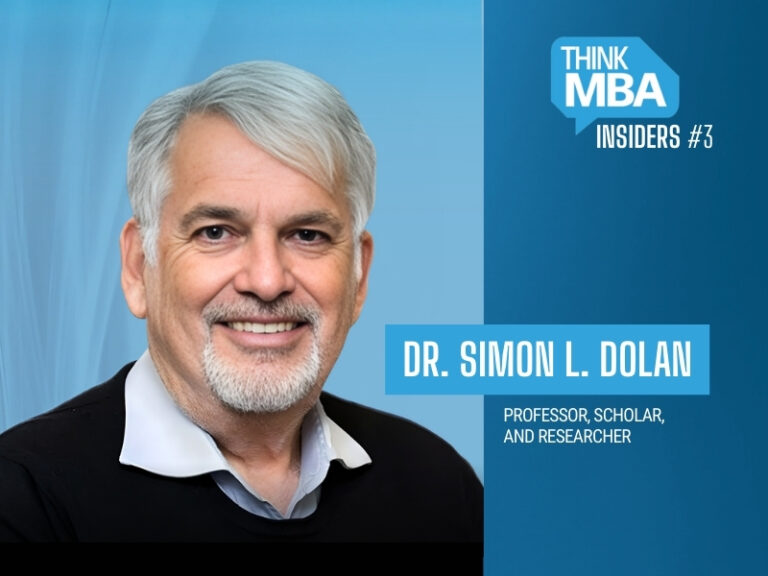
There are MBA courses … and then there are MBA courses. How can an aspiring candidate identify the right course for their particular needs? And, anyway, is the MBA still the right course for our changing times? Prof. Simon Dolan comments on these questions and more.
For this MBA Insider feature, we sat down with Prof. Simon L. Dolan, an inspiring professor, scholar, researcher, book writer, and visionary figure in the fields of HR, culture reengineering, stress management, leadership, coaching, and the future of learning in today’s rapidly changing work environment.
Prof. Dolan has taught at some of the leading business schools of the world: Minnesota, Boston, and Colorado in the U.S., Montreal and McGill in Canada, ESSEC and HEC in France, and Pompeu Fabra and ESADE in Spain. In addition, he was a visiting professor at universities around the globe, including in the Middle East, Europe, many Latin American universities, China, Singapore, and Japan.
As President of the Global Future of Work Foundation and former Chair of the Future of Work at ESADE Business School, he is at the forefront of shaping modern management practices. Prof. Dolan is a thought leader whose innovations, such as The Stress Map, Stress for Resilience, and Learning about Values, are making a significant impact on organizational well-being.
What is your view about MBAs?
Prof. Dolan has been teaching MBAs for about 40 years, and explains that when one talks about MBAs, one needs to talk about the past, present, and future.
“MBA today is no longer the end of a professional contribution to the company or to the individual’s personal development.”
“In the past, MBAs equipped managers to be more professional, more ethical, and to add value to whatever they did,” he recalls. “If you look at the ROI, the revenues per input in many companies, an MBA degree certainly added value, so for the company, it was a good investment to hire people with MBAs — these were professional, well trained and, whatever they learned, it would be used in the company and it would increase the economic value and other values of the company.”
The rapidly changing marketplace requires a change in skills, according to Prof. Dolan, who explains that an MBA today is no longer the end of a professional contribution to the company or to the individual’s personal development.
When students are being trained by a good MBA school, and Prof. Dolan puts the accent on a good MBA school, “they will be prepared for today’s marketplace, but I can’t affirm that they will be prepared for tomorrow’s marketplace.” He highlights, “Today we refer to lifelong learning, because everything keeps on changing.”
What advice would you give to help students seeking the right MBA?
Prof. Dolan emphasizes that one of the challenges students face in choosing an MBA program is conducting a careful examination of the school they will choose.
“There is a lot of demand for MBAs, but the offer has also started to increase, and I wouldn’t say that the quality remains the same,” he reflects. “The quality of many of the MBA programs on offer is not good and, unfortunately, for the past 15 years the low quality has been diluting the reputation of MBA programs.”
- General reputation and ranking of the MBA: These are the first things to look at, but they shouldn’t be exclusive.
“Although the ranking of the degree may grant a candidate a greater chance of getting their first job, as an MBA from a top-ranked university will impress potential employers, they won’t be kept in the company if they don’t deliver,” he says.
- Make sure the MBA is equipped for today’s and tomorrow’s market demands: it is not enough to look for an MBA with basic theory in the field (marketing, finance, accounting, management, etc.).
“It is important to find out if the program has an intelligent mix of two types of skills. First, there are the hard skills, which haven’t changed a lot but have just been updated. Then there are the soft skills, which are the most difficult to learn; it’s about learning to become a good leader, to work in a team, and to communicate effectively with one’s team, one’s colleagues, etc.,” explains Prof. Dolan.
“Soft skills have a lot to do with many things, and many business schools know it, but they don’t know how to develop curriculum, how to develop content, and how to develop competence,” he says. “For example, traditionally, doctorate degrees used to benefit from high recognition. But this is not enough, because doctors also need to be effective communicators.”
- Look at the professor ratings by the students: the student should use GPA to find out about the professor and see whether they are still publishing or if they are out of date.
How long does it take to see an ROI, and how can it be assessed?
Prof. Dolan admits that he doesn’t have an easy answer on how to assess ROI for an MBA, but he says that it would depend very much on the individual’s personal situation:
- If they don’t have to quit a job while committing to an MBA program;
- If the job is guaranteed after completing the MBA;
- If the person is the CEO of their own company and is obliged to risk leaving their position to someone else to manage, etc.;
- It will also depend on how big the investment is, not just in financial terms but in terms of time.
“Today’s trend is start-ups potentially becoming new companies; some of today’s MBA student colleagues will become best allies in the future.”
How can students make the most of their MBA network?
It is well known that one of the key advantages of doing an MBA program is benefiting from the network of colleagues. The interaction between alumni not only provides valuable feedback, but also adds value from different perspectives.
“Network is key!” Prof. Dolan stresses. “Today’s trend is start-ups potentially becoming new companies; some of today’s MBA student colleagues will become best allies in the future.”
Networking with your colleagues provides an overview of their capabilities, loyalty, values, and the potential synergy you will experience with them in the business world.
He explains: “In today’s “glocal” (global and local) economy and work environment, networks characterized by their diversity, mixed skills, and cross-cultural assets are more valuable than homogeneous environments, which won’t play in your favor in the long run.”
How do you know when the MBA program is working effectively?
Prof. Dolan explains that schools often provide key statistics that attract students, such as:
- How long it takes for an MBA student to get a job
- Their salary
- How many students were employed within the first six months, and the first and second year following graduation
- Their entry pay level
- How many students who graduated became entrepreneurs, and what the survival rate of their businesses was
- How long their start-ups lasted, and whether these entrepreneurial ideas were sustainable, and are still in place
“The probability of success of a start-up within the first five or 10 years is not very good; only around 30 percent of start-ups survive,” he admits.
How will AI and technology impact and reshape business education?
In today’s digital technology landscape where, whatever one does, wherever one turns, it’s a major driver of success, “One needs to have some way of knowing the ABC of digital technology and get prepared,” he says. “A business school can’t really help prepare the student to keep on updating information all their life. So, in other words, one of the skills is to be autodidactic.”
But with technology, especially with artificial intelligence, comes the plagiarism issue and the ethical implications. “That’s why business schools should integrate a class about the use of tech in an ethical manner. No matter the field of study, the ethical question remains critical,” he reflects.
Can you compare and contrast education systems in, let’s say, the US, Spain, and Japan?
Prof. Dolan has taught at some of the leading business schools of the world and has the cross-cultural experience to comment on systems from different regions. He responds:
- An MBA at ESADE in Spain is much more intentional. Students are willing to innovate and take risks more than in other countries.
- In Japan, they are very systematic, and training needs to be aligned with Japanese values. They may not notice that they’re not responsive enough to the changes in the market, but they still work to satisfy the local market in Japan.
- The US is in a real crisis because the ranking is shifting rapidly. Unfortunately, the political system doesn’t encourage this heterogeneity. Therefore, Indian and Asian students are not attracted as much as they used to be to come to high-ranking US schools and universities. As Europe is catering to the future of employment, the region is competing against the US, which still has high prices.
“In the past, Harvard wielded great influence in the US, but I am not a supporter of the method based on case studies that characterized the teaching from this university,” he admits.
Prof. Dolan says, “We need to train students to be able to solve problems that are new. We are flooded with problems that we didn’t have before, such as the COVID case, and who knows if the next epidemic is going to be COVID again?”
What is the impact of hard skills versus soft skills in an MBA?
“I think the idea of MBAs in general, not of the quality of the MBAs, is in crisis and this is difficult to resolve. I would say that 20 to 80 percent of MBAs will not satisfy their market demand. I am a big supporter of what I called the cousin of the MBA, the DBA, the Doctor of Business Administration.”
Prof. Dolan admits that he is really pushing for the Doctor of Business Administration, as he says that it gives much more time and can really do a good job in both hard and soft skills, and in addition, the program can be personalized.
“If you want to prepare students for the future, you need to take a risk of doing something different. It doesn’t have to be at 100 percent, but at least a margin of about 20, 25 percent.”
What are the skills taught in MBAs in order to be employable in 2026, and how will The Global Future of Work Foundation support candidates in the job search?
Prof. Dolan admits that “this is the million-dollar question, because the market is very confusing at present, and one needs to have not only one’s own compass, but also an external compass”. An external compass is an idea about where the market may be heading. What are you going to do towards the big change in the future? Can one align the internal compass, the education, the knowledge, the know-how with the future? He says that three drivers explain the transformation in the market:
- Number one is technology, and its impact. “So, in addition to whatever one learns, one needs also to have the skill to de-learn and relearn,” he says. Otherwise, one becomes obsolete, because the digital world and the virtual world are going to be dominant.
- Second, the market is not local anymore. “It is a global market, and one needs to develop global competencies, and learn the culture of the place, wherever one goes.”
- And the third is that creativity should be the driver. “To create means taking risks,” he reflects. “There is no risk because when you say: No, no, no, we are the best. Let’s not change. Let’s not rock the boat. Yeah, you’re the best today. Nobody guarantees that you’re going to be the best tomorrow, because the market changes.”
He adds: “I use the metaphor of a pendulum. You know, when you move a pendulum a bit, you also take a limited risk. When you move a pendulum a lot, the distance between creativity and sheer stupidity is very close.”
Prof. Dolan explains that at present they are developing the DBA, which is a Doctor of Business with a focus on future work. We need to jump into the future, we need to be able to think in abstract terms.
“We create the DBA, which is fully virtual and in four languages, so the roles are reversed here. There is no program,” he admits. “This is what I thought the MBA of the future would look like; why do we need to have a program that fits everyone? People are different, and they have different needs. So what I’m saying is that the idea is to fit the program into the person and not the person in the program, but eventually you create a kind of hybrid futuristic MBA program. But I also want to create a social debate,” he concludes.