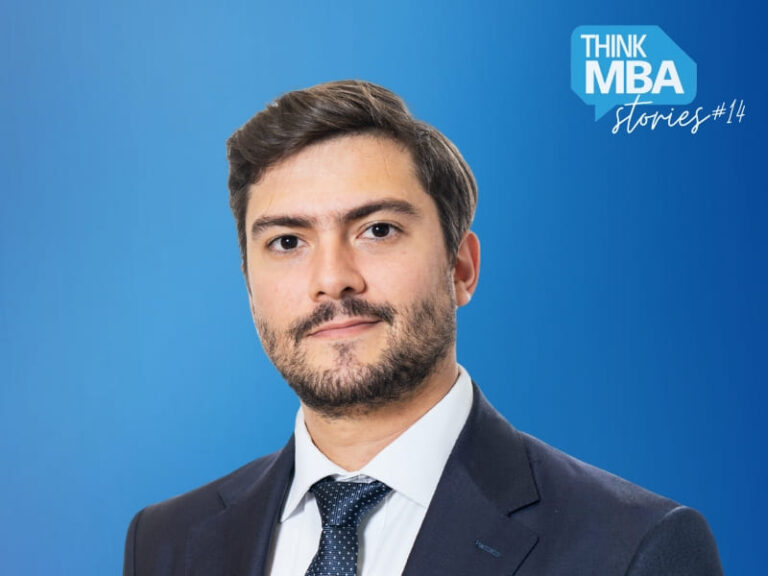


Engineering Meets Entrepreneurship: How IMD’s MBA Helped Jasper Schakel Launch CIWI

Editor’s Note: In this installment of ThinkMBA’s Real Stories, we spotlight how an IMD MBA can turn deep technical expertise into venture-ready leadership.
After a few years of technical work, Dutch engineer Jasper Schakel decided to step away from pure engineering and pursue an MBA. His decision was not just about boosting his career – he was also seeking to create a more sustainable impact.
Today, as co-founder of CIWI, a water technology startup based in the Netherlands, he credits his IMD MBA for giving him the mindset and tools to turn his engineering knowledge into entrepreneurial action.
Making Engineering Impactful
“I also wanted to be a person who is able to build up an organization so you can also make a sustainable change in this kind of field.”
Originally trained in mechanical engineering, Jasper later specialized in water treatment techniques – a field that sparked his passion for sustainability. He recalls, “I once saw this graph from the United Nations that says by 2030 we will have a shortage of water around 40%. As an engineer, I want to be part of this solution.”
After early work in the Netherlands, Jasper moved to Ghana to gain hands-on experience tackling water challenges. That experience, he says, opened his eyes.
“I quickly realized that a technical solution is not enough. There also must be some economic logic behind it to be able to build a sustainable organization behind a solution so you can also implement it.”
When Jasper decided to pursue an MBA, he didn’t see it as a shift away from engineering, but rather as a way to make his technical expertise more impactful. “I wanted to be more than just somebody who is able to make a technical design,” he explains. “I also wanted to be a person who is able to build up an organization so you can also make a sustainable change in this kind of field.”
Choosing IMD
That realization led him to pursue an MBA at IMD in Switzerland, one of Europe’s top business schools. For Jasper, the decision to study there was as much about fit as it was about reputation. “What I really like about IMD is that we only have 80 classmates,” he says. “You get a really personal connection with the professors so you can build a really strong network.” The school’s focus on sustainability and impact also resonated deeply with him. And then, he admits with a smile, “it doesn’t hurt that it’s located in Switzerland, in Lausanne, in beautiful surroundings.”
His year at IMD was both intense and transformative. “They work you so hard that you are so tired in the weekend. Everyone says at the end of the year, ‘I wish I had invested more in relationships with my classmates.’” The demanding environment was also part of what made it so rewarding. “Entrepreneurship can be taught,” he recalls a professor saying – a lesson that helped him realize, “Hey, I can also do this. I can set up a business.” That realization quickly turned into reality. During the program, Jasper entered IMD’s Venture Award competition – and he won. The prize came with seed funding and a promise: to try out the business idea for at least a year. “And now, almost two years later, we have a startup running in the Netherlands,” he says.
During the program, Jasper entered IMD’s Venture Award competition – and he won. The prize came with seed funding and a promise: to try out the business idea for at least a year.
CIWI: A Sustainable, Local Solution to Water Treatment
That startup is CIWI, a young company tackling one of Europe’s most overlooked sustainability challenges: the supply of water treatment chemicals. “In Europe only one percent of the output of the chemical industry is water treatment chemicals,” Jasper explains. “If that supply stops, the entire west of the Netherlands doesn’t have access to drinking water.”
CIWI’s solution is local and sustainable. “We have a system that we put in a container next to existing treatment plants,” Jasper says. “Using green electricity, salt, and steel, we can make water treatment chemicals on location – making drinking water more dependable, resilient, and sustainable.”
Now two years in, CIWI is already working with a quarter of the Dutch market and raising €3 million to accelerate growth. Jasper credits IMD for helping him build a company that mixes engineering with business logic. “They didn’t give me long theoretical texts,” he says. “They gave me a list of do’s and don’ts – and I’ve been implementing that ever since.”
An MBA = A Startup Cheat Code
Jasper talks of having an MBA as a ”cheat code” to help avoid typical start-up problems. ”We still make mistakes and we still learn from those but I do feel that because of the things we have been taught, it is very easy for us already to look ahead and say: ‘Okay, we are here now, and based on our education, we’ll probably face these kinds of issues in a year’s time, so let’s prepare for them now.’”
He also points to one key lesson that changed how he approaches innovation. “The problem of engineers is always that they fall in love with the technology and forget what the customer does with it”. Instead, Jasper and CIWI have learned to be ”faithful to the customer and unfaithful to the technology”.
For Jasper, the MBA was both a professional and personal transformation. “They send you to a psychologist for a whole year to analyze yourself and understand what drives you,” he says. “After one year, you know better what you want in life and what makes you tick.”
If asked whether an MBA is still worth it, he doesn’t hesitate. “If you want to invest in yourself, yes, it’s worth it,” he says. “So it’s really about self-development. So putting yourself out there, making yourself uncomfortable and learning something new. You don’t do it for anyone else.”
And his advice for future students? “Give it your 110%. It’s only one year – the more you put in, the more you get out,” he says. “Those who approached it just for the diploma are struggling the most now. They give you the tools, but you still have to build it yourself.”
“Those who approached it just for the diploma are struggling the most now. They give you the tools, but you still have to build it yourself.”