

Beyond the Credential: What an MBA Really Teaches Future Leaders
Editor’s Note: The ThinkMBA Insider Series looks past rankings and course lists to ask a more urgent question: what is business education really developing in today’s leaders? Through in-depth conversations with experienced educators, the series explores how MBA programmes are adapting to an era defined by AI, complexity, and constant disruption.
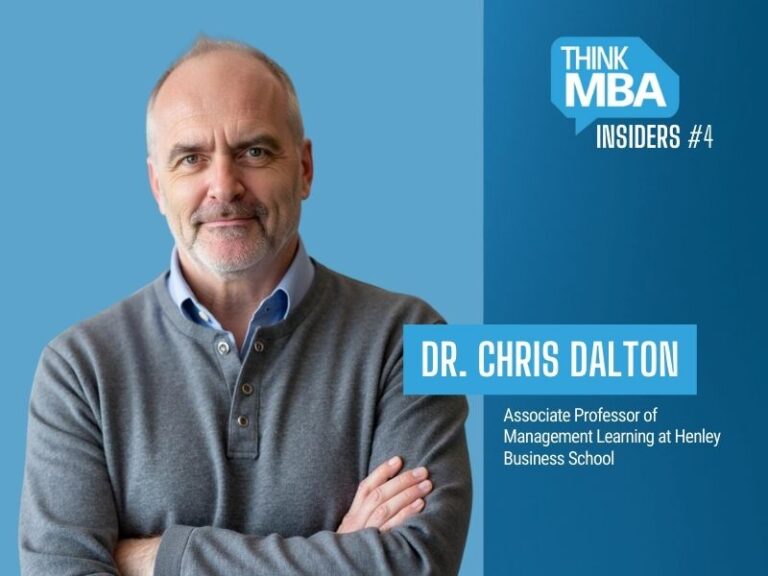
In this edition, we speak with Dr Chris Dalton, Associate Professor of Management Learning and module convener for Personal Development at Henley Business School, and a recipient of the University Teaching Fellowship. With nearly three decades of experience in management education, including leadership roles in MBA programs across Europe and beyond, Dalton brings both practitioner and scholarly insights to the discussion. Drawing on his own MBA journey, extensive teaching experience, and research on reflection and leadership development, he challenges the idea of the MBA as a credential alone, arguing instead for its role in shaping judgment, self-awareness, and the capacity to think well under pressure.
ThinkMBA (TA): 1. What led you to pursue an MBA yourself, and how has that experience shaped your perspective as an educator and mentor?
Chris Dalton (CD): I did my MBA because I wanted a serious indication of academic ability. One part of this was about knowledge, and a stronger way of thinking about organisations, but the main motivator was to prove to myself that I could do it. I was already working in education, so the MBA itself was a world I was interested in understanding.
“Definitions of careers change, industries change, but the quality of your attention, thinking, and relationships tends to endure.”
That experience continues to shape me as an educator. I don’t see the MBA as a content-delivery exercise. I see it as a development process. It’s a chance to build judgment, learn how to learn, and become more intentional about the kind of professional person I’m becoming.
As an academic and tutor, I’m always looking for the human being behind the professional role. Definitions of careers change, industries change, but the quality of your attention, thinking, and relationships tends to endure.
TA: When people question whether an MBA still holds value, how do you respond?
CD: If someone asks it sincerely, I’m all in. It’s the right test. An MBA isn’t valuable by default, and programmes differ hugely. The payoff depends on the learner’s intent, the quality of the cohort, and whether the programme is designed to develop judgement, not just deliver content.
If you treat it as a badge, you’ll walk away with a badge. If you treat it as a structured interruption – a period of deliberate practice in thinking, communicating, collaborating, and deciding—it can be transformative.
The world is changing. Information is cheap, AI can generate plausible text in seconds, so memorised knowledge is no longer the scarce resource. The scarce resource now is sense-making, which is critical thinking on what to trust, what matters, what to do next, and how to do it with others.
So my response is that the MBA’s value has shifted away from data input to the development of judgment about data output. And judgment is still hard to automate.
TA: At what point did the benefits of your MBA become clear, and how did they differ from what you expected?
CD: Not on graduation day. More quietly, later, in the two or three years after finishing. Mainly, it was in the moments when I noticed I was thinking differently.
What felt like early benefits were frameworks, vocabulary, some sense of status, and yes, a widened horizon of options. The longer-lasting benefits were slower. The MBA gave me (or I gave myself as an MBA) a stronger internal compass, greater comfort with ambiguity, and improved ability to ask better questions under pressure.
What surprised me was that the real shift was identity-level.
TA: Looking back, what proved most impactful long term: career direction, relationships, leadership growth, or something else?
CD: If I have to choose one, it’s the institution I studied at, Henley. The MBA was rigorous and long, but what really held it together were the relationships with the faculty and the collegiate principles that encouraged peer-to-peer conversations. The relationships are a special case when you’re in a good MBA cohort. These become reference groups that people carry for years.
Career direction matters, of course, as do alumni networks (usually quite close-knit, small groups), but the long-term impact for me has been to work with thousands of other people who have elected to find out what the MBA can mean to them. Each case is unique, and everyone is basically the same. I wouldn’t truly understand that as an academic if I hadn’t travelled that path as a student.
TA: What behaviours or mindsets distinguish students who gain lasting value?
CD: A few patterns come up repeatedly. The first is curiosity over performance. They’re less preoccupied with looking clever and more committed to learning how to learn.
“The MBA was rigorous and long, but what really held it together were the relationships with the faculty and the collegiate principles that encouraged peer-to-peer conversations.”
If the programme has invested in the personal development aspect, then this reflective mindset means the MBA is a safe place to test ideas, behaviours, and assumptions. I probably spend most of my time developing workshops and materials to support people in this. This means they build relationships deliberately. It’s not transactional networking, it’s genuine peer learning, mutual challenge, mutual support.
Henley’s Executive MBAs are all part-time, so everyone integrates learning with real work. They don’t keep the MBA in a separate mental box; they apply, observe, and adjust. All the case studies are real.
TA: Reflection plays a central role in your work. How can MBA students use reflection during their studies?
CD: Every regular MBA assignment has a required section to reflect on at the end, and there are three compulsory Personal Development assignments during the course. However, reflection isn’t a diary. It’s a discipline of paying attention.
The simplest practice I recommend is to build a learning rhythm around four moves:
- Notice (what happened, what you felt, what you avoided),
- Accept (see reality without defending or condemning it),
- Engage (get curious to find out “What’s really going on here?”)
- Act (small behaviours to test in the real world)
Used properly, reflection is how you turn experience into learning, and learning into practice. Without it, the MBA becomes a fast-moving carousel of models and deadlines. With it, the MBA becomes a coherent developmental story of patterns you can see, assumptions you can challenge, and choices you can make more consciously.
TA: Practical steps to get the greatest possible value from an MBA
CD: I’d suggest a few very concrete ideas.
1. Write a personal learning note to yourself before you start (three parts of you want to build, not just topics you want to study).
2. Use your cohort as a learning community, not an audience or a competitive field. Find a small group of people who will challenge you honestly. Talk to people from other industries or roles, that’s a given, but talk also to characters or personalities who are not similar to you. Learn from the differences.
3. Make your work a live case study as much as you can. Go and knock on the C-suite office doors (perhaps virtual doors) and ask them what they do, what they worry about, and so on. You won’t have a better excuse than, “I’m doing an MBA.
4. Protect your energy. An MBA can become an endurance sport. Sustainable performance beats heroic burnout. Be kind to your friends and family – you won’t complete the course without their support (or not as easily!). Celebrate with them at the end.
5. Use AI wisely. Let it help you draft, compare viewpoints, and interrogate assumptions, but keep the judgment, the ethics, and the voice as yours. Think with it.
TA: How do you see the role of the MBA changing, and what capabilities will future graduates need?
CD: The $64 question!
I think the MBA will become less about mastery of management knowledge and more about mastery of adaptation and readiness. None of us can predict the future, so practice keeping an open mindset when the context keeps shifting.
It’s no longer debatable that we’re moving into a world of AI-augmented work, tighter constraints (environmental, geopolitical, regulatory), and faster and more fragmented reputational dynamics. In that world, future MBA graduates will need:
- Sense-making and critical thinking
- Systemic and holistic thinking
- Self-awareness (sounds easier than it is)
- Ethical judgment (not as a module, but as a lived capability)
“None of us can predict the future, so practice keeping an open mindset when the context keeps shifting.”
The usual human skills that scale, such as listening, conflict navigation, psychological safety, and trust-building. These staples will stay. However, the MBA’s job is to come up with better questions.

About the Author
Dr Chris Dalton is Associate Professor of Management Learning at Henley Business School and convener for Personal Development. A University Teaching Fellow, he teaches on the MBA and DBA. His research explores reflection in management education. He has authored four books and brings three decades of global management education experience. The third edition of his book, “MBA Day by Day“, published by Pearson is released in January 2026.