Contact Us
[email protected]

How an MBA Builds Leadership Confidence and Long Term Career Momentum
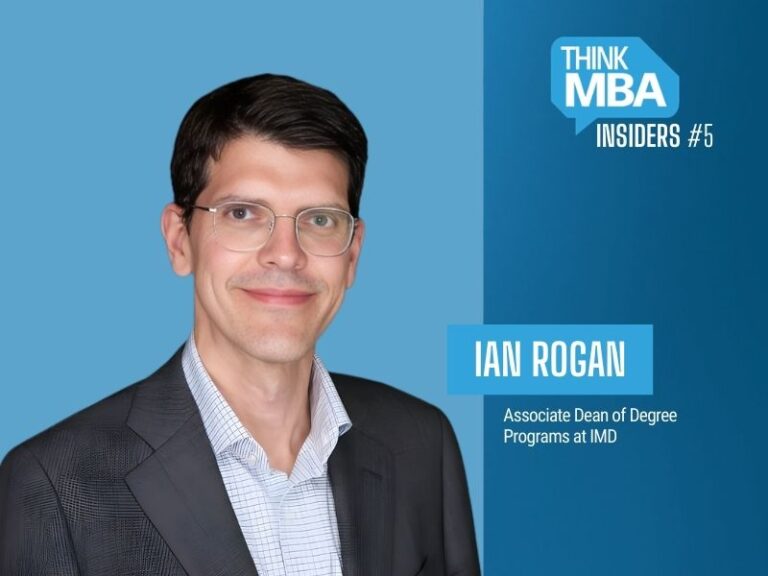
Editor’s Note: The ThinkMBA Insider Series looks beyond rankings and employment statistics to examine a deeper question: how is the MBA shaping leaders for an increasingly volatile and technology-driven world? Through in-depth conversations with those who design and deliver leading programmes, the series explores how business education is evolving to remain relevant in an era defined by AI, shifting career paths, and constant reinvention.
In this edition, we speak with Ian Rogan of IMD, who has worked extensively with MBA candidates and alumni across different stages of their professional journeys. Drawing on his own MBA experience and years of guiding leadership development, Rogan reflects on the enduring value of the degree, the realities behind return on investment, and why self-awareness, adaptability, and purposeful growth are becoming the true markers of MBA success.
ThinkMBA (TA): When you think back to your own MBA experiences, what were the personal questions or uncertainties you were hoping the degree would help you work through at that stage of your life?
Ian Rogan (IR): Looking back, I was trying to understand two things: Firstly, what kind of leader I wanted to become, and secondly, whether I could stretch myself into roles that demanded broader strategic and interpersonal capabilities than I had at the time. Like many candidates, I wasn’t only seeking new skills — I was seeking clarity, confidence, and a stronger sense of purpose. An MBA provides a structured environment for this self‑inquiry: the combination of rigorous academics, diverse peers, and leadership development creates the space to test your assumptions about yourself and discover strengths you didn’t know you had. I chose IMD because I believed at the time, 2008, and continue to believe that we offer the strongest leadership development experience in the world among MBA programs.
“The return on investment isn’t only financial — it’s the confidence to navigate complexity with purpose.”
TA: Given everything you have seen since then, both as graduates and as leaders shaping MBA programs, how do you now explain the value of an MBA to someone unsure whether it is still worth the commitment?
IR: The IMD MBA remains uniquely valuable because it compresses years of development into one intense, intentionally designed year. Beyond knowledge, the degree delivers three increasingly rare things: deep self‑awareness and personal growth; a powerful, diverse community; and an immersive environment for experimentation — a safe but demanding space to take risks, to lead, to fail, and to build resilience. In a world where careers shift rapidly and linear paths are disappearing, the MBA gives individuals a platform to reinvent, refocus, and accelerate. The return on investment isn’t only financial — it’s the confidence to navigate complexity with purpose.
TA: From your perspective, when do most graduates begin to feel the benefits of an MBA in a meaningful way, whether in career momentum, confidence, or decision making, and are expectations often aligned with reality?
IR: Most IMD MBAs begin to feel the shift during the program — often around the midpoint — when experiential projects, leadership labs, and real‑world application start to reinforce new capabilities. That said, the career impact tends to crystallize in the months immediately after graduation. We are very honest with our prospective MBAs about what the IMD MBA can and cannot do for them, which helps keep their expectations aligned with reality, but those who engage fully in the experience often see benefits that exceed initial expectations.
TA: Of all the outcomes an MBA can deliver, which ones tend to matter most over the long term as careers evolve and become less predictable?
IR: At IMD, we aspire to develop MBAs who have increased self-awareness, are more adaptable, possess transversal skills that remain critical in a fast‑changing world, and have the ability to learn continuously. These, combined with a global, trusted network built through an intimate cohort experience, enable our MBAs to succeed over the long term.
“Have some clarity on what you hope to achieve, but let the year challenge and reshape that perspective.”
TA: After working with thousands of MBA students across different schools, what habits or mindsets do you see in those who truly get the most out of the experience?
IR: The students who thrive share several mindsets: curiosity, self‑honesty, generosity in contributing to peers’ learning, resilience in embracing intensity, and proactivity in engaging with career development resources. They experiment, reflect, seek feedback, and put themselves into situations where growth is inevitable.
TA: If a candidate were about to start their MBA tomorrow, what practical advice would you give them to make sure the experience pays off both personally and professionally?
IR: Arrive with intention but maintain an open mind. Have some clarity on what you hope to achieve, but let the year challenge and reshape that perspective. Treat the year as a full‑life experience, not just an academic one; your classmates, study groups, and experiences will shape your thinking and relationships for years to come. Above all, participation matters — you get out what you put in.
TA: Looking ahead, how do you see the role of the MBA changing in the years to come, and what should future candidates focus on to stay relevant in a rapidly shifting world?
IR: The future MBA will be less about mastering fixed bodies of knowledge and more about shaping leaders who can navigate volatility, engage with advanced technologies, and drive meaningful impact. Three shifts stand out: greater emphasis on human capabilities such as judgment and self‑awareness; integration of AI and data literacy into all aspects of the curriculum; and a stronger focus on purpose, sustainability, and societal value. Future candidates should cultivate adaptability, reflective capacity, and a mindset of continuous reinvention.
“Future candidates should cultivate adaptability, reflective capacity, and a mindset of continuous reinvention.”

About the Author
With over 15 years in management education, Ian Rogan is Associate Dean of Degree Programs at IMD, where he designs impactful learning experiences for global leaders. Previously, he led MBA and part-time programs at Copenhagen Business School and held leadership roles at Oxford Saïd and Yale SOM. He holds an MBA from IMD.