Contact Us
[email protected]

Inside MBA Admissions: What Applicants Get Wrong and Schools Look For
Editor’s Note: Choosing an MBA has never been more complex or more consequential. Marketing promises abound, yet the real signals of a strong program often surface only once students arrive.
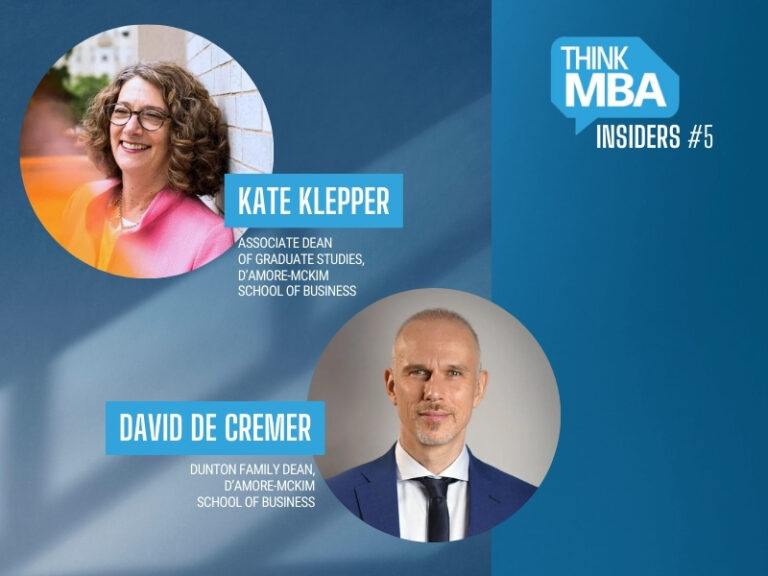
In this episode of the MBA Insider series, Kate Klepper and David De Cremer of Northeastern University’s D’Amore-McKim School of Business pull back the curtain on how MBA programs assess candidates and how applicants should evaluate schools in return. From application essays and interviews to networking, AI, and the future of management education, they offer a candid look at what truly matters and where many applicants go wrong.
ThinkMBA (TA): How should prospective students evaluate MBA programs beyond marketing claims to avoid disappointment?
Kate Klepper and David De Cremer (K&D): Remember, everyone is putting their best face forward, including schools and students/candidates. Both parties need to pay attention to what’s being said and what’s not being said. And to ask questions! If you have particular interests or specific concerns, you must learn as much as you can through the evaluation process. Additionally, what has happened in the past is an example of what MAY occur when you attend school, but remember that in today’s world, everything changes quickly. Your classmates will be different from those you meet on a campus visit, and your employment opportunities will be different too – companies and economies change.
“What has happened in the past is an example of what MAY occur when you attend school, but remember that in today’s world, everything changes quickly.”
Part of the evaluation process from the school side involves application essay questions – that’s a first step in the school getting to know you. Answer the questions. Don’t try to figure out what the school wants to hear. What we want to hear is your honest response to the question.
TA: From your experience, what signs during orientation or early weeks predict whether an MBA program is well run?
K&D: The only predictable thing is that something will go wrong – not drastically, but enough that the team will need to pivot. The hallmark of a well-run program is its ability to pivot, doing so without a lot of drama. When there is a sense of calm in what could be a chaotic situation, that demonstrates that the program team knows what they’re doing, they have created a plan, confirmed all that can be confirmed, and if one thing hits a snag, it’s dealt with and things continue as otherwise planned. When a hiccup occurs and that throws folks into a frenzy, that may be a sign of concern.
TA: Many applicants find MBA essay prompts vague or abstract. What’s their real purpose, and how can schools make the process fairer?
K&D: Application essays are a critical part of the MBA application. Every school and admissions committee will consider them differently, but we believe most of us are trying to get to know you better. What is your thought process? How are you organizing your thoughts? In the case of the question – Why are you applying now? Or why my school? Or how is the MBA going to further your career? We really want to know – have you thought about these things? Can we help you meet your goals?
TA: What are the most common mistakes MBA applicants make during interviews, and how can they better prepare?
K&D: Being unprepared is a big red flag. It’s very evident when a candidate is ‘going through the motions’ and has not researched the school or the program. When they fail to ask any questions or ask very simple questions that could be answered with a quick look at the website. A candidate who treats every application and interview to business school as generic will not come across as one who is interested, or interesting.
Another mistake is focusing too much on yourself. Have all your accomplishments been individual efforts? If so, we are going to be concerned with how you’ll do working on a team. A lot of Business-school assignments and teaching are team-oriented. Have you led a team or a project? How did that go? What about when you were NOT the leader, how did you handle that?
TA: How can students make the most out of their MBA network during and after the program?
“If it’s not working or you’re not getting the results you were hoping for, seek feedback, re-evaluate, and amend your strategy.”
K&D: There is no substitute for showing up. Attend networking events, introduce yourself to class visitors, go to alumni events, tap into the alumni network, create a plan or a strategy, and execute that plan. If it’s not working or you’re not getting the results you were hoping for, seek feedback, re-evaluate, and amend your strategy. Opportunities are not going to wait for you to be ready; they will happen on their own time – it’s up to you to manage your time, prioritize appropriately, and start networking from day one. Your classmates are a good place to begin. Long after you graduate, this is the group you will remain most closely aligned to – create those bonds early, and often.
TA: In your view, how has the MBA degree evolved to stay relevant in today’s economy?
K&D: The MBA continues to evolve. The inclusion of more technology-driven content, the responsible use of AI, and the management of a remote workforce. All of these factors are part of what students will learn, along with foundational business content in the MBA of today.
The MBA is one of the most applicable degrees available. Every organization, for-profit, not-for-profit, arts organizations, healthcare organizations, banks, consultancies, and higher education, are ALL dependent on sound business practices and principles. As the world of work evolves, so must MBA programs.
TA: What kinds of roles or industries are most in demand for recent MBA graduates right now?
K&D: Organizations are looking for individuals who are fluent in the technology of the workplace. The tools will continue to change and evolve, and people want to hire those who have proven they can and are eager to learn and stay current. Every role touches or is touched by technology – leading and managing in tech-driven environments – this is true across industries, more so now than in the past, partly due to the rapid nature of change and adoption of technology.
TA: How do you see AI and tech changing the way business education is delivered?
K&D: We believe there is wider acceptance of technology as a tool to deliver education. We don’t foresee AI replacing humans teaching content, but we do believe it will help reinforce concepts, aid in the iterative process of learning, applying, gathering feedback, and applying again. We think AI will impact both sides of the education process, those who are delivering and those who are receiving – faculty and students will discover new ways to employ AI and AI tools. These lessons are part of the learning process, one that will continue long after graduation.
“We don’t foresee AI replacing humans teaching content, but we do believe it will help reinforce concepts, aid in the iterative process of learning, applying, gathering feedback, and applying again.”

About the Authors
Kate Klepper is the associate dean of graduate studies at D’Amore-McKim School of Business, Northeastern University, US.

David De Cremer is the Dunton Family Dean of D’Amore-McKim School of Business, Northeastern University, US.