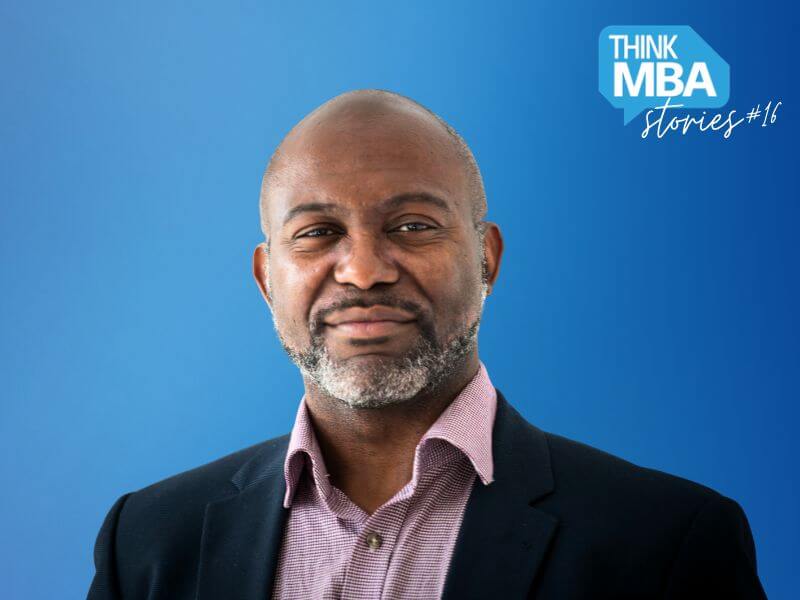


Sam Perry on Why Building a Business Can Be More Valuable Than an MBA

After 20 years in the corporate world, one executive chose entrepreneurship over an MBA, discovering that building a business offered lessons no classroom could replicate.
In this edition of ThinkMBA Real Stories, we feature Sam Perry, Group Vice President at Sphera, whose career journey spans more than 20 years in the corporate world and a successful move into entrepreneurship. In this Q&A, Sam reflects on why he chose to build a business rather than pursue an MBA, how launching and selling a startup shaped his understanding of risk and resilience, and why practical experience, self-belief, and knowing your values matter when navigating a career.
1. You had been considering an MBA for some time when your role came to an end in 2022. How did that experience shape the way you approached your next career move?
I’ve always valued MBAs, and I haven’t ruled out doing one in the future. But when I was offered a redundancy package in 2022, it gave me the space to think carefully about what I wanted next.
Rather than immediately looking for another job, I explored taking time out to study. I was particularly interested in the bigger-name business schools, but the cost was substantial. Even outside those schools, an MBA would have been a significant investment.
A friend encouraged me to consider starting my own company instead. I took that route, and within two years the business was acquired. For me, at that stage in my career, the experience of building and selling a business was more valuable than studying for an MBA would have been.
“Starting a business gave me a chance to put those strengths to work and invest part of my severance in something I could build myself.”
That doesn’t mean the door is closed. It just wasn’t the right choice for me then.
2. You decided to use part of your severance pay to start a business rather than pursue an MBA. What made entrepreneurship feel like the better choice at that point?
Cost was the biggest factor. If I could comfortably have afforded an MBA at Harvard, I probably would have done it.
But I also had to be honest about my strengths. I prefer doing something than reading about it. I am incredibly driven when I have something to work towards. Starting a business gave me a chance to put those strengths to work and invest part of my severance in something I could build myself.
It was still a risk, but it felt like one that suited me.
3. After 20 years in the corporate world, what surprised you most about running a business of your own?
How hard it is to make that first sale when you’re starting from nothing.
After 20 years in the corporate world, I thought I understood selling. Starting my own company tested that understanding completely. You must create something valuable, earn someone’s trust, and persuade them to pay for it, without an established business behind you.
Going from zero to one & then 1 to 10 was much harder than I expected. It was also incredibly rewarding, because every sale was evidence that someone believed in what I was building.
4. What did building a startup teach you about business that you think would have been difficult to learn in a classroom?
The emotional side of running a business. You can study strategy and finance, but it’s harder to recreate the pressure of making decisions when your own money and livelihood are involved.
“I think an MBA can be particularly valuable for someone who enjoys structured learning and has a clear idea of how the qualification will help them progress.”
Building a startup taught me a great deal about managing myself through uncertainty: handling setbacks, staying motivated, and understanding how emotions affect decisions and relationships.
That experience is now one of my greatest strengths. I can draw on situations I’ve actually lived through, including the difficult ones.
5. Your startup was acquired within two years. Looking back, what did the experience teach you about risk, resilience, and learning as you go?
It taught me that resilience is much more practical than it sounds. Some days, it means dealing with the worry of paying your mortgage while still finding the energy to speak to customers and make a sale.
As a bootstrapped founder, you have to keep finding a way forward. You won’t always know the answer, so you learn, adapt, and try again.
I still believe it’s hard to beat someone who doesn’t give up. But persistence also means being willing to change your approach when something isn’t working. You have to stay committed while learning as you go.
6. You had concerns about the cost of an MBA and whether it would improve your career prospects. How should people weigh those risks against the potential benefits of further study?
I’d start by being clear about what you want the MBA to help you achieve. Is it a career change, access to a particular industry, a stronger network, or a deeper understanding of business? Then consider whether the likely benefits justify the fees and the time away from work.
Personally, I wouldn’t have been comfortable taking on significant debt for an MBA. Other people may reach a different conclusion based on their circumstances and ambitions.
For me, the strongest combination is academic knowledge and practical experience. The question is which one you need most at that point in your career.
7. If you could give your younger self one piece of career advice, would it be about education, taking risks, or something else entirely?
Know your values and hold on to them.
The corporate world can put those values under pressure, sometimes gradually enough that you barely notice. My advice would be to stay yourself, be honest, and work hard, even when compromising feels like the easier route.
Ambition matters, but so does being proud of how you’ve achieved something.
8. Having experienced both corporate leadership and entrepreneurship, who do you think would benefit most from an MBA, and who might be better served by learning through work?
I think an MBA can be particularly valuable for someone who enjoys structured learning and has a clear idea of how the qualification will help them progress. Someone who learns best by doing may get more value from taking on greater responsibility at work or building a business.
“The strongest combination is academic knowledge and practical experience. The question is which one you need most at that point in your career.”
Like I said early, I prefer doing something than reading about it and I’m very driven and resilient. Entrepreneurship gave me an environment where I could develop and use those strengths.
That said, if I were interviewing someone who combined an MBA with meaningful practical experience, I’d be very interested. Someone who understands the theory and has had to put it into practice brings a powerful combination.

About the Author
Sam Perry is Group Vice President at Sphera, with over 20 years of experience scaling SaaS and technology businesses across Europe and North America. He specialises in global go-to-market strategy, commercial leadership, and entrepreneurship. He previously founded a procurement technology startup that was acquired by Sastrify.